Crystal Singing Bowl Intervals: Which Notes Sound Good Together
If you own one crystal singing bowl, the next question is usually which bowl to buy next, or which notes to sing against it. The answer is the same in both cases: the intervals that sound stable and safe above your root note. This guide gives you a chart for every root, songs that help you find each interval by ear, and an honest summary of the research.
The four safe intervals
Count up from your root note in semitones (each step on a piano, black notes included).
Major third: 4 semitones. Warm and bright.
Perfect fourth: 5 semitones. Open and settled.
Perfect fifth: 7 semitones. Spacious and complete.
Octave: 12 semitones. The same note, higher.
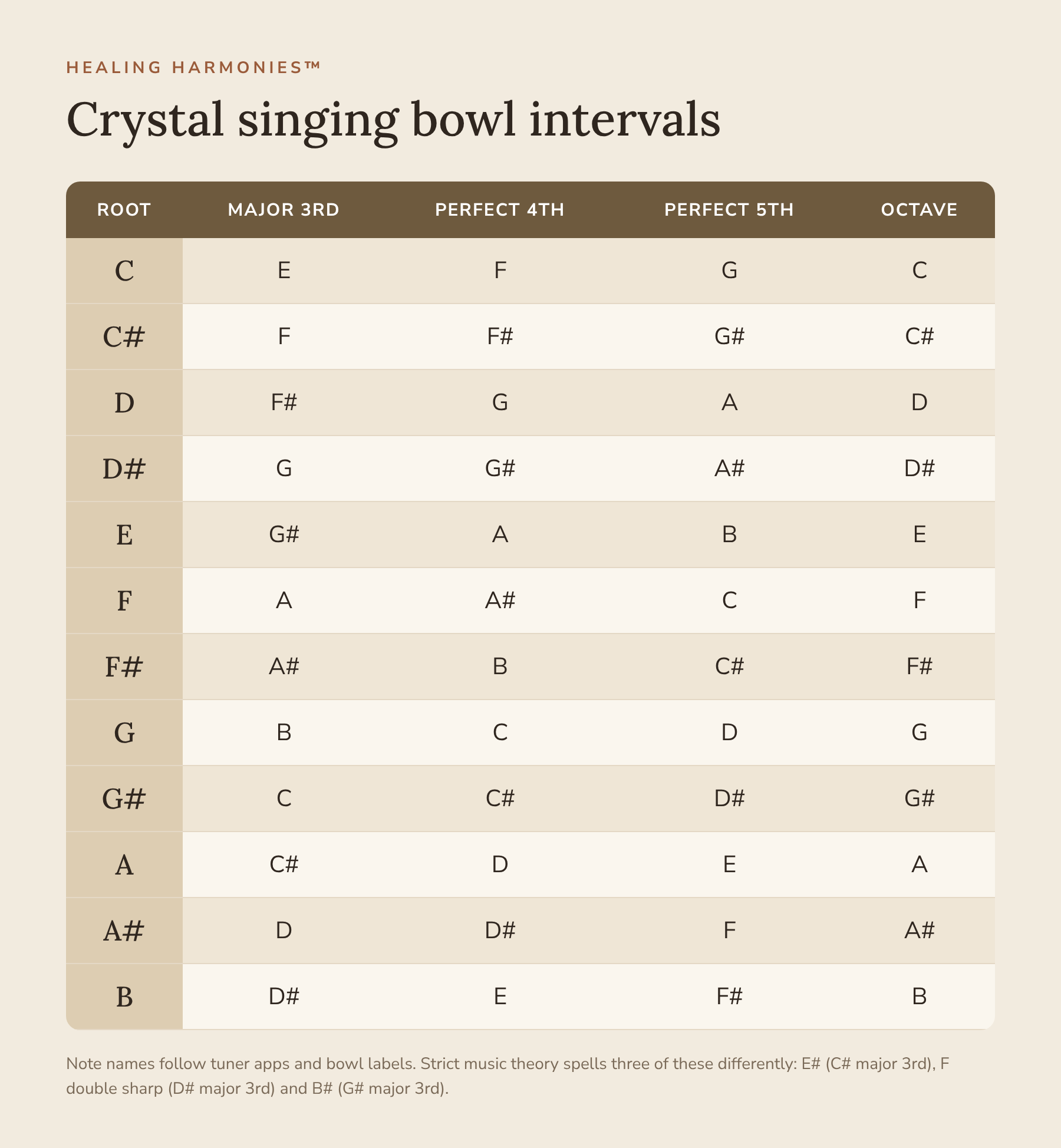
Chart for every root note
Note names follow what tuner apps and bowl labels show.
Find them by ear
The first two notes of each song make the interval. Hum them before you sing against your bowl.
Major 3rd - Kumbaya
Perfect 4th - Here Comes the Bride; Amazing Grace
Perfect 5th - Twinkle Twinkle Little Star
Octave - Somewhere Over the Rainbow
Major or minor: only the third changes
People often describe major as happy and minor as sad. Between a major and a minor key, only the third changes: the major third is 4 semitones, the minor third 3. The fourth and fifth are called "perfect" and are the same in both. So the major third is the interval that carries the bright quality. There is no such thing as a "perfect third", a phrase that turns up in some sound healing materials.
What the research says
Western listeners have described major-mode music as happy and minor as sad since at least the 1930s (Hevner, 1935).
Children as young as three already link major music with happy faces (Kastner & Crowder, 1990).
Tempo matters as much as mode, and often more. Slow music sounds calmer even in a major key (Gagnon & Peretz, 2003).
Babies prefer consonant intervals to dissonant ones (Zentner & Kagan, 1996), and the brainstem encodes the octave, fifth, fourth and major third more strongly than dissonant intervals (Bidelman & Krishnan, 2009).
The happy-major link is largely learned. In remote communities in Papua New Guinea with little exposure to Western music, major versus minor made almost no difference to emotional responses (Smit et al., 2022).
So consonance, the stable feel of these intervals, is the more universal part. The happy quality of the major third is real for most clients raised on Western music, and may differ for others.
Many sound healers also teach specific meanings for each interval, such as the third bringing hope or the fifth bringing completion. These come from practitioner tradition, notably Fabien Maman's work, and have not been tested in research. They are worth exploring in your own practice, as tradition.
Building a bowl set
If you are adding a second bowl, the fifth above your root gives the most spacious pairing. A third bowl at the major third completes a major chord. Your voice can fill in the rest, as our guide to singing with crystal singing bowls explains.
Notes a step apart, such as B and C#, create a wavering "beating" sound. That is acoustic beating between two tones in the room. It is not the same as binaural beats, which need a different tone in each ear through headphones. Use close notes sparingly, especially with anxious clients.
Learn to use these intervals with your voice
Healing Harmonies is a one-day, in-person sound healing training in the East Midlands. You will practise these intervals with your own bowl and voice, and learn why steady, consonant sound helps people rest. Book your place on the course page.
References
Bidelman, G. M., & Krishnan, A. (2009). Neural correlates of consonance, dissonance, and the hierarchy of musical pitch in the human brainstem. Journal of Neuroscience, 29(42), 13165–13171.
Gagnon, L., & Peretz, I. (2003). Mode and tempo relative contributions to "happy-sad" judgements in equitone melodies. Cognition and Emotion, 17(1), 25–40.
Hevner, K. (1935). The affective character of the major and minor modes in music. American Journal of Psychology, 47(1), 103–118.
Kastner, M. P., & Crowder, R. G. (1990). Perception of the major/minor distinction: IV. Emotional connotations in young children. Music Perception, 8(2), 189–201.
Maman, F. (1997). The role of music in the twenty-first century. Tama-Do Press.
Smit, E. A., Milne, A. J., Sarvasy, H. S., & Dean, R. T. (2022). Emotional responses in Papua New Guinea show negligible evidence for a universal effect of major versus minor music. PLOS ONE, 17(6), e0269597.
Zentner, M. R., & Kagan, J. (1996). Perception of music by infants. Nature, 383, 29.