

Human Design as Therapeutic Language + Framework
A structured way to meet each client as an individual, and a disciplined way to test whether you have read them accurately. This is a course about exploring the language of differentiation to help clients deepen their understanding of self.
Six months of personal and professional development for practitioners who want a richer language for difference, and who want to hold that language ethically and honestly.
Re-opening Soon

What this training is and isn’t
Human Design for Therapists™ is continuing professional development. It is a reflective framework that sits alongside your existing training and accreditation. It does not replace them, and it does not qualify anyone to practise as a therapist, counsellor or clinician.
Human Design is not a clinical assessment, a diagnostic instrument or an evidence-based treatment. Nothing taught here should be used to withhold, delay, modify or substitute for clinical care, medical advice or prescribed treatment.
Where this course draws on neuroscience and psychology, I say so and I cite it. Where it draws on metaphysical or traditional material, I say that too. You will always know which you are being given.
Certification on completion is issued by Rebecca Lovatt Humble Warrior Ltd. It is not accredited by any external regulatory body and confers no protected title or professional status.
You remain bound by the ethical framework and scope of practice of your own professional body. Where this training and that framework appear to conflict, your professional body governs.
Who this course is for
This training is built for people already working in a therapeutic, coaching or healing capacity, or actively training towards it. Therapists, counsellors, psychologists, coaches, complementary practitioners.
It is deep, layered professional development. It is not an introduction to Human Design as a personal curiosity, and it will not qualify you to practise as a therapist.
If you are not currently practising and want to learn for your own development, you are welcome and this has been a real joy of the course - this isn’t just about client facing work but personal growth too. However, the whole course is pitched with therapy adjacent language, so if that feels unfamiliar to you, this might also not be the course for you.

How this course changes the therapy delivered in the room
Most therapy is delivered one way and adjusted later, if at all. The client who isn't taking to the protocol gets read as resistant, or unready, or not yet in the right place, when often they are simply being offered the wrong way in for them, or need different interventions for their unique makeup.
Some people arrive at clarity by talking.
Not by insight, not by homework, by hearing themselves say it out loud, repeatedly, until it lands. Handed a worksheet and told to keep busy, they will comply but get nowhere. The chart gives you a reason to ask about this in week one rather than week six.
Some people can reach for a feeling easily, and some need a way in.
Where a therapy depends on emotional access, like EMDR for example, it helps to know early whether your client recalls emotion readily or needs a prompt: music, image, movement, something outside themselves. That is a pacing question, not necessarily a suitability question.
Some people find speech itself effortful.
Not shy, not guarded… genuinely inconsistent access to their own words. For those clients a creative or embodied route to expression is not a lesser option, it is the one that works. A therapist who can spot that easily and refer is serving their client well.
None of this predicts whether a given therapy will work, and none of it overrides your clinical judgement or your training. It gives you a structured set of hypotheses to bring into the room early and then test, out loud, with the client. Does that land? Where does it fit or not fit? A chart your client can argue with is doing its job even better than one they fully agree with blindly. A chart they simply accept has become a label accepted without question, and labels are the opposite of what we are here for.
Imagine having that conversation in session one, rather than session six. And having a shared language to continue the therapeutic relationship, which is often where I find this modality most helpful.
A note on language, and what I have changed my mind about
This training has run before, but it is not the same course it was in the beginning.
The earlier version of this page made claims I would not make now. It suggested that a chart could tell you which therapies would suit a client, in determinative rather than exploratory language which I now use. I believed that when I wrote it, on the strength of what I had observed through years of practice. But I’ve come to realise observation is where a hypothesis starts, but it is not necessarily where it finishes.
What changed my thinking was the work I have been doing on how symbolic systems actually affect people. The research is consistent on one point in particular: what a reading reliably produces is not accuracy, it is certainty. People leave more sure of themselves than they arrived, whether or not what they were told was true. That effect is strongest when it comes from someone positioned as knowing, which describes every person this course is written for.
So a training that hands therapists a system for reading clients, without also handing them the discipline to doubt it, does not make the work safer. It makes the practitioner more confident and the client less able to disagree. That is the outcome I most want to avoid, and the previous version of this page was quietly selling it without me really realising it.
What that means in practice: you will not be taught to know things about your clients before you meet them. You will be taught to arrive with better, more individually focussed questions, offer them plainly as a language you both share, and treat a mismatch as information rather than resistance. Every module now includes the discipline of asking where the chart does not fit. This is also a thread that follows through my Soul Map work too.
I have also started marking my own material by how well it is evidenced, rather than letting the well-supported parts lend their credibility to the rest.
Why Human Design?
It gives clients a shared object to inspect, rather than a label to accept
It reconnects people to their body and to interoception as a source of information
It is visual, so a client can see the pattern rather than only hear it described
It is experimental by design. It invites testing, and it survives being wrong
It separates conditioning from tendency
It is individual, and it holds difference without pathologising it
Human Design is not a trend. It is a structured language for the architecture of the self, and like any language, its value depends entirely on the care of the person speaking it.

Hi there, I’m Becky, and I eat, breathe, sleep Human Design and Transits for personal development, healing and growth.
I’ve been using astrology for as long as I can remember, but Human Design came to me at the end of 2019, beginning of 2020, when I was finishing my yoga teacher training. Having always been hooked by philosophy, I began to appreciate the structure that human design gave us for exploring ourselves, our habits, beliefs, behaviours, and growing. It made learning about myself fun, practical and relatable. And ever since then, I’ve been learning like a hungry hippo, giving individual readings since around 2022.
Alongside that, I continued to work in the wellbeing sector privately, promoting body safety, nervous system health, self understanding and self enquiry through meditation, mindfulness, yoga, cacao… really any modalities I could train in to help people in my community.
And now I’m bringing it all together. Because over the last 5 years I’ve had countless personal and professional dealings with mental health services, both in the public and private sectors, through various different types of therapy, and I can see there’s massive room for improvement (and that’s not a dig, by the way… our services are good, but they can be even better). It’s time for individual approaches that can be really clear and impactful, using modalities like Human Design. Solid, structured, empowering guidance for both therapists and clients. And that’s what I’ve built.
A strong, well researched (nearly 7 years in the making!) course that leaves no stone unturned when it comes to self enquiry, using Human Design, with a sprinkling of philosophy to encourage the expansion of our minds and critical thinking skills.
And I can’t wait to deliver this course!
Becky x
Testimonials & Case Studies
“I have learnt so much about myself and others around me and I will forever be looking at people through a different lens!”
“The course is presented in a way that is logical and layered so you are building on your knowledge week by week. It’ll change the way you see yourself and others and how you can work with your design to help you on life’s path. ”
Watch the last free workshop, all about the power of understanding your own, and your clients, authority (intuitive body signal)
The Neuroscience of Self-Discovery
Therapy, at its heart, is the exploration and integration of the self.
Modern neuroscience tells us that the “self” is not a fixed entity but an emergent process, shaped by memory, emotion, perception, and prediction. Rather than existing in one location, our sense of identity arises from dynamic interaction between networks in the brain and nervous system, such as the prefrontal cortex, limbic system, and what researchers call the default mode network (DMN), the system involved in self-reflection and narrative identity.
In other words: The brain is constantly constructing a coherent story of who we are.
As a therapist, much of your work supports clients in refining that internal narrative, bringing patterns into awareness so they can be integrated, re-authored, or released.
Human Design as a Cognitive Map
From a neuroscience perspective, the brain processes complex information more effectively when it is organised into structured, patterned representations. Cognitive psychology shows that we understand ourselves through ‘schemas,’ mental maps that organise experience into meaning.
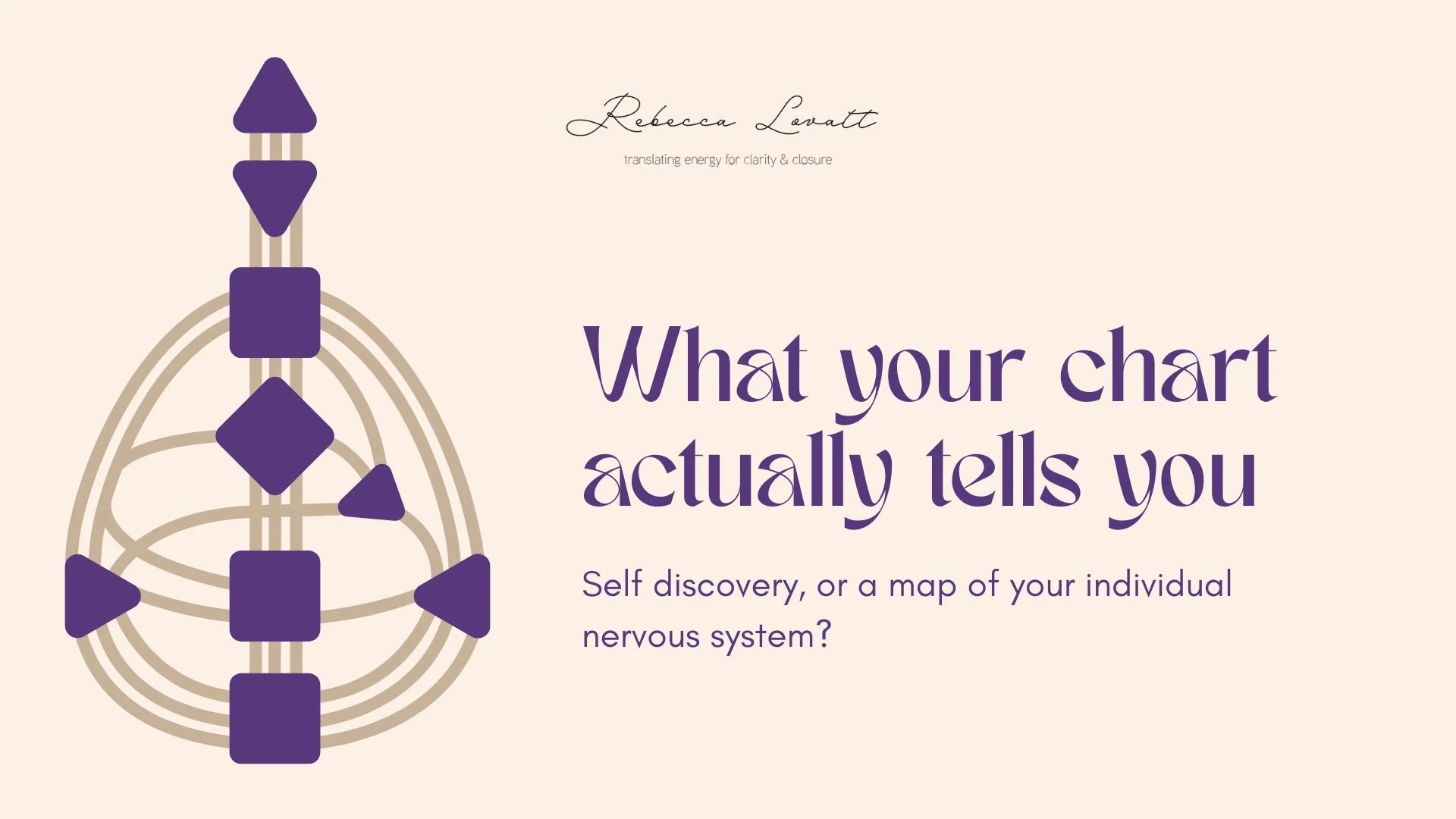
Human Design functions as a structured, visual identity map.
The bodygraph becomes a reflective scaffold, a way of SHOWING internal patterns so that clients can see them, question them, and relate to them differently. Rather than generating identity from scratch in dialogue, the framework provides a template through which clients can:
Recognise recurring patterns
Differentiate conditioning from core tendencies, and
Build a more coherent narrative of self
This is not about pathologising or diagnosing. It is about offering structure to exploration.
A Neuro-Aligned Reflective Tool
While Human Design is not a neuroscience-based clinical assessment, it operates in parallel with several well-established psychological principles:
The brain organises experience through patterns.
Visual mapping reduces cognitive load.
Coherent narrative strengthens identity integration.
Insight emerges when implicit processes become explicit.
In this way, Human Design can function as a neuro-aligned reflective tool, supporting clients in organising complex internal experiences into accessible language and form.
For therapists, this offers something powerful:
A template for discovery that complements therapeutic dialogue.
Not as a replacement for clinical skill, or as a diagnostic instrument.
But as a structured lens through which identity can be explored, differentiated, and integrated.

The Modules
Module One
(7 Weeks)
The history and background - epigenetics, the neutrino stream story, collective consciousness as a concept, the work of Carl Jung and Astrological Psychology, and neuroscience approach to building a sense of self
Energy types, strategy and auras - how we’re all build differently to experience life and carve our own path
The shadow archetypes and not self themes
Profile lines for driving daily life - promoting focus and alignment in daily life for less overwhelm
Life initiations and the planets at play
The intuition - Authority, Cognition and the Moon
Undefined centres - the sponges, the mirrors and the amplifiers of energy in the body
Defined centres for consistent, fixed and useful skills, and improving the sense of self
Module Two
(9 weeks)
The 64 Gates as capacity, skills, talents and village archetypes
Understanding the difference between shadow and light gates to help clients orientate and regulate
The 36 Channels as personal assets and village needs for life purpose and growth
Bridging the gap between personal development and collective development for developing a sense of purpose in life (the individual and the village)
Relationship charts to support relationship mediation and understanding
Module Three
(7 weeks)
Narrative repair after illness. Using the bodygraph to help clients rebuild a sense of self after diagnosis, treatment or long-term illness. This is story work, not symptom work.
The variables: external safety, pacing and mental support in session design
Human Design as parts work: Creating an understanding of how the gates work as villagers within us, pushing, pulling and guiding, and how balancing the parts creates a more harmonious environment. We will look at this from both a natal perspective and transit perspective for dynamic practice.
Initiations and transits - the main aggravators of personal development and how to spot and work with those individual initiation points.
Daily rhythms and retrograde patterns for pacing, planning and individual growth plans.
The heroes journey - how understanding the suns movements in real time can create a powerful story and appreciation for life’s ups and downs
The final map, and building your own supervision practice around this work

By the end of this 6 month container you will be able to
Speak the language of Human Design fluently, and say honestly where each part of it comes from
Read a chart and form clear working hypotheses about what a client may need from you
Invite a client to disagree with their chart, and treat a mismatch as information rather than resistance
Recognise when chart language is delaying care, and refer without treating it as a failure of the work
Adapt your existing offerings to the individual in front of you, within your own scope of practice
Hold decisions with clients rather than for them, even when they ask you to decide
Use the session planning tool to build coherent, sustainable session structures
Continue in the learning portal, and know where to take the sessions that trouble you
“Beneficial on a personal and professional level — the information is delivered in stages that perfectly layer together to help with your confidence and understanding.
”
“I was fascinated by how Human Design can be integrated to provide greater depth and understanding of a person.
”
Three Payment options
Pay in Full
One off payment
£1500
Pay Monthly
Spread the cost
£275 p/m x 6
Payments will begin upon checkout, and will be taken monthly until all payments have been made.
Pay Monthly
Spread the cost
£138 p/m x 12
Payments will begin upon checkout, and will be taken monthly until all payments have been made.
Course Delivery & Learning Method
This is an online training, weekly via Zoom
Sessions will be recorded if you cannot make the live, but live participation is recommended for the full benefit
You will also receive weekly worksheets, cheat sheets and examples of application where necessary, to build your bank of information over time.
Each online session is approximately 90 minutes long
For certification, there is the requirement to complete 5 case studies to demonstrate you have understood the content
Certification is not accredited to a body, and is issued by Rebecca Lovatt The Humble Warrior Ltd
The course includes access to 1:1 sessions going forwards should you want them for self development or learning development
This course is most suitable for those practicing as a therapist or counsellor in any field. It is not designed for people who are not already accredited counsellors, therapists or coaches and is a CPD or additional training to be undertaken. The hours are equivalent to a 100 hour CPD including case studies and homework.
There will be optional weekly practical homework to help you learn more about yourself to be able to apply this information to your own practice and life too
I highly recommend subscribing to Genetic Matrix Pro version as early as possible and getting to grips with the software. This is the software we will be using going forwards.
-
There are various price structures, with a pay in full option, monthly option, and early bird discounts available. Please scroll down a little further to see the details of all those options.
-
This training is suitable for anyone who is a therapist, coach, or working in mental health / development services. It is suitable for people not currently practicing, or who just want to learn for self development, but please note, this has been designed with therapists in mind (counsellors or other complimentary therapists), and is NOT a training to become a therapist. This is an additional training for those looking to diversify their offerings.
-
Refunds can be given within a 14 day period of sign up.
Once the course has begun, there are no refunds to be given, and if you are signed up via a payment plan, monies owed will be claimed. If you need to book a discovery call because you’ve not worked with me before in any capacity, please email me at becky@thehumblewarrior.co.uk and I will happily organise one to make sure our energies fit. Otherwise, please join the free workshops on the build up to this course going live (scroll up and you’ll see those!) so you can appreciate my teaching style and background.
The Dates - Spring/Summer 2026
All sessions are 7pm UK TIME / Online via Zoom + recorded
Every Thursday from 23rd April - 24th September
Each session is approximately 75 minutes plus time for questions and reflections
Please note there’s a small chance there could be some changes to the date schedule, but you will receive plenty of notice of this alongside recordings from the sessions you may not be able to make live.
Final Thing
This work is unregulated. Infact this whole sector is, which is precisely why it should be held carefully and why I am putting in solid ethical frameworks into my work to protect the integrity of the modality, the therapy, and the client.
There is no no protected title, no regulator, no required training. So the standard is whatever we agree between ourselves. This course is my attempt at one: a framework I believe in deeply, taught with the discipline it deserves, and explained honestly so you know what you are working with, from several years experience in the field.